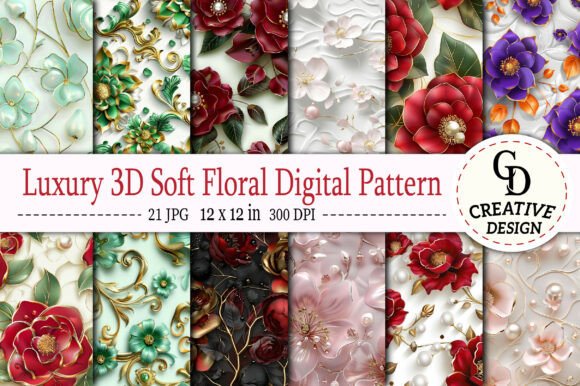
Evaluating 3D Floral Seamless Digital Paper for Your Creative Projects
In the realm of digital design and crafting, texture and depth often determine the success of a project. 3D Floral Seamless Digital Paper has emerged as a distinct resource for designers seeking to move beyond flat, two-dimensional patterns. Unlike traditional vector graphics or simple raster images, these files utilize shading, lighting effects, and layering techniques to simulate physical dimensionality. For adults aged 20 to 50 who are navigating the complexities of digital scrapbooking, web design, or print-on-demand services, understanding the specific utility of this format is essential before committing to a purchase.
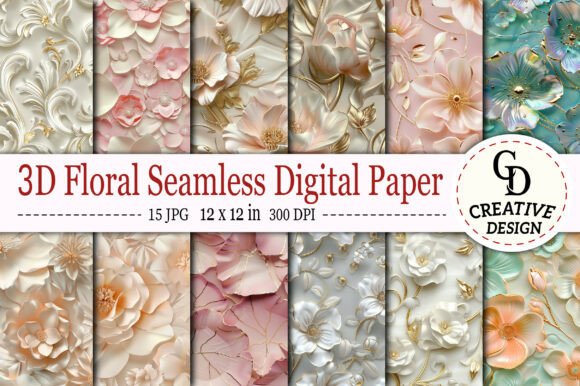
The primary distinction of 3D Floral Seamless Digital Paper lies in its ability to mimic real-world materials without the logistical burden of physical inventory. When you download a set containing 15 high-quality JPG files at 12×12 inches and 300 DPI resolution, you are acquiring assets ready for immediate professional application. However, the decision to use this specific type of digital paper requires a balanced evaluation of your project requirements, output medium, and long-term scalability needs.
Defining the Distinctive Qualities of 3D Textures
To understand why 3D Floral Seamless Digital Paper stands out, one must first analyze what constitutes "seamless" and "3D" in a digital context. A seamless pattern is designed so that when repeated horizontally and vertically, the edges align perfectly, creating an infinite background without visible breaks. This is critical for tiling backgrounds on websites or wrapping textures around 3D models in rendering software.
The "3D" aspect refers to the visual treatment of the floral elements. Instead of flat silhouettes, these designs incorporate gradients, shadows, and highlights that suggest volume. The petals appear to lift off the background, and leaves cast subtle shadows on adjacent surfaces. This illusion of depth adds a tactile quality to digital work, making it particularly effective for projects where realism or a premium aesthetic is desired. For instance, a wedding invitation template using these papers will convey a sense of luxury that flat clip art simply cannot achieve.
Comparing Formats: JPG vs. Vector Alternatives
When evaluating resources, a common comparison arises between raster formats like JPG and vector formats such as SVG or EPS. The 3D Floral Seamless Digital Paper described here is provided in JPG format. This choice is deliberate and carries specific tradeoffs that users must weigh against their technical capabilities.
JPG (Raster) Advantages:
- Visual Fidelity: Raster formats excel at handling complex gradients and soft shadows required for 3D effects. Vectors can sometimes struggle to replicate the nuanced lighting of a photorealistic flower without becoming excessively large and difficult to manage.
- Print Readiness: At 300 DPI, these files meet the industry standard for high-quality printing. The 12×12-inch canvas size is the gold standard for scrapbookers and card makers, ensuring no pixelation occurs when printed on standard home printers or professional offset presses.
- Compatibility: JPGs are universally supported by almost every design software, from Adobe Photoshop to Canva and Cricut Design Space.
Vector Alternatives:
- Scalability: If your primary need is to resize a single flower element to billboard size without losing quality, a vector file would be superior. However, 3D Floral Seamless Digital Paper is intended as a background or surface texture, where infinite scaling is rarely necessary.
- Editability: With vectors, you can change the color of a petal instantly. In a JPG, color changes require manual editing tools. If you need to customize the hue of every element in the pattern, a vector-based approach might be more efficient.
For most hobbyists and small business owners, the convenience and visual richness of the JPG format outweigh the limitations. The tradeoff is acceptable because the files are delivered at a fixed, high resolution suitable for the vast majority of print and screen applications.
Assessing Use Cases and Best-Fit Situations
Determining whether 3D Floral Seamless Digital Paper is the right tool depends heavily on the end goal of your creative endeavor. These assets are not a one-size-fits-all solution, but they excel in specific scenarios.
Ideal Applications
- Digital Scrapbooking and Journaling: The 12×12-inch format is purpose-built for this community. Users can drag and drop these papers into layouts to create backgrounds that add depth without overwhelming photos.
- Surface Pattern Design: For those designing fabrics, wallpaper, or gift wrap, the seamless nature of these files allows for continuous tiling. The 3D effect adds a sophisticated touch that elevates product mockups.
- Web and UI Backgrounds: While 300 DPI is higher than typically needed for screens, downscaling these images results in incredibly crisp, detailed backgrounds for landing pages or mobile app interfaces.
- Crafting with Cutting Machines: When using machines like Silhouette or Cricut, these papers serve as excellent printable backdrops for stickers, labels, and cards.
Situations Requiring Alternatives
There are instances where this specific resource may not be the optimal choice. If you are working on a project requiring transparency (e.g., placing a floral pattern over a video), a PNG format with a transparent background would be necessary. Similarly, if you need to animate individual flower parts, a layered PSD file or vector asset would provide the flexibility that a flattened JPG cannot. Additionally, if your project involves large-scale architectural signage, the 12×12-inch source file might require significant upscaling, which could introduce artifacts; in such cases, a native vector or larger raster file would be safer.
Understanding the Value of Resolution and Dimensions
A critical factor in the evaluation of any digital asset is its technical specification. The inclusion of 300 DPI resolution in this collection is a significant indicator of quality. DPI (dots per inch) measures the density of pixels in a printed image. Standard screen resolution is often 72 DPI, which looks fine on a monitor but appears blurry when printed. By providing files at 300 DPI, the creator ensures that the intricate details of the 3D shading remain sharp even when reduced to smaller sizes or printed on high-end paper stocks.
The 12×12 inch dimension is equally important. This square ratio is the industry standard for craft supplies. It eliminates the need for cropping or resizing, which can distort the perspective of the 3D elements. When you download a digital instant download package, knowing the exact dimensions allows you to plan your layout with precision. You do not need to guess if the pattern will fit a standard album page or a greeting card front; it is designed specifically for these constraints.
Weighing the Pros and Cons of Instant Downloads
The nature of this product as a digital instant download introduces a different set of considerations compared to purchasing physical paper. There is no shipping time, no risk of damage during transit, and no storage space required for stacks of physical paper. You receive access to 15 unique designs immediately upon purchase.
Advantages of the Digital Format:
- Cost-Effectiveness: Without manufacturing and shipping costs, digital papers are generally more affordable than high-quality physical counterparts.
- Sustainability: Printing only what you need reduces waste. You can test a design on a small scale before committing to a full print run.
- Variety: A single download provides 15 variations, offering a cohesive palette without the clutter of buying multiple physical packs.
Potential Limitations:
- Tactile Experience: Some crafters prefer the feel of textured physical paper. While the 3D effect simulates texture visually, it does not replicate the physical embossing or weight of handmade paper.
- Technical Barrier: Users must have access to a printer and basic design software to utilize the files effectively. Those unfamiliar with digital workflows may find the transition challenging.
Making an Informed Decision
Ultimately, the choice to integrate 3D Floral Seamless Digital Paper into your workflow should be driven by your specific project goals. If you value visual depth, professional print quality, and the versatility of digital manipulation, this format offers a robust solution. It bridges the gap between the convenience of digital assets and the aesthetic richness of physical materials.
However, if your project demands extreme scalability, animation, or physical textural interaction, you may need to explore vector alternatives or physical paper stocks. By carefully considering the resolution, format, and intended application, you can ensure that your investment yields the best possible results. Whether you are a seasoned designer or a hobbyist exploring new avenues, understanding these nuances empowers you to select resources that truly enhance your creative vision.